Air-travel inaccessibility for fat passengers
Shrill: Notes from a Loud WomanAir-travel inaccessibility for fat passengers is the combination of airplane seating and boarding conditions that prevent larger travelers from using a paid service without painful constraint, uncertainty, and social scrutiny. In Lindy West’s account, the issue becomes concrete in 2013, when she discovers that she no longer fits comfortably in a plane seat. Flying then requires not simply getting from one place to another, but planning around a design that treats her body as an exception and a culture that often blames passengers for the discomfort that design creates.
The first discovery and its context
Before that change, West was fat but still able to move through a world organized around smaller bodies with comparatively little disruption. She could not wear regular-size women’s clothing and had to navigate cramped spaces carefully, yet she understood herself as someone who mostly fit into the straight-sized world. During a busy professional year, after flying about twenty times in eight months, she traveled to Texas and found that the outbound flight was manageable while the return journey was not. Sitting down, she had to force herself into the seat. The abrupt difference made an ongoing structural problem newly personal: the boundary of what an ordinary seat could accommodate had become impossible to ignore.
The discovery took place against a wider culture that treated fatness as a public problem and used purported concern about health to license contempt. In discussing the mid-to-late 2000s, West describes a popular campaign against obesity that framed fat people as burdens on healthcare, airplane neighbors, and children, and contrasted them with supposedly more virtuous thin people. Dan Savage participated in this climate, defending his refusal to accept that someone could be obese and healthy. West describes having only recently begun to question some of the same assumptions herself. The airplane conflict thus sits within a larger struggle over who is considered worthy of accommodation and whose body is treated as evidence of personal failure.
The bodily and logistical burden
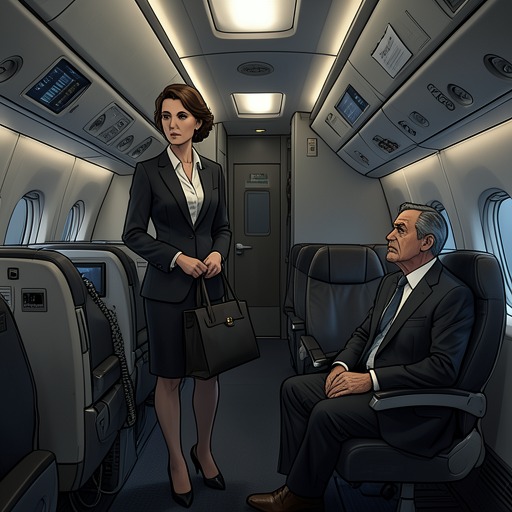
West describes the seat as an angular enclosure narrower than her hips, making prolonged sitting physically painful. On one eight-hour flight from Oslo to Seattle, she spent the journey in distress, unable to find an easy position. The problem is not identical on every trip: seat widths and belt lengths differ by aircraft model and airline. That variation turns boarding into an uncertain test, with no dependable way to know whether the seat will fit or whether an extender will be needed. The possibility of asking for one also carries the prospect of embarrassment in front of seatmates.
In response, West develops an elaborate routine intended to reduce both discomfort and the attention her body might attract. She books only a window seat, even if that means sitting in the last row or changing to an extremely early flight, because the space beside the window gives her a little more room to position herself. She avoids emergency-exit and bulkhead rows, which she has learned may be narrower, and arrives at least two hours before domestic flights to avoid having to hurry down the aisle. The day before a trip, the coming flight is already on her mind.
Other parts of the routine are organized around not having to get up once seated. West uses the bathroom repeatedly before boarding, waits near the gate so she can board early and settle into her row before others, and discreetly asks a flight attendant for a seat-belt extender as she enters. She chooses the window partly to avoid blocking access for other passengers when she has to get in or out. Once seated, she tries to remain unobtrusive. Taken together, these steps show how a single journey extracts advance planning, time, and emotional energy well beyond the purchase of a ticket.
First class as a contrast
West’s experience of first class clarifies the distinction between luxury and basic access. Its drinks and meal do not prove especially luxurious, and the seat is not an extravagant throne; its main advantage is ordinary adequacy, including a human amount of legroom. More importantly, first class relieves the dread associated with not knowing whether a seat will accommodate her. What initially appears to be an excursion into luxury instead reveals how little a passenger can expect from the standard cabin: for West, it is the first time in recent memory that flying has allowed her to feel like a human being.
That contrast redirects attention from the fat passenger to the service being sold. Most travelers have limited control over the price and conditions of air travel, while airlines have little incentive to address the problem unless the public demands it. West rejects the suggestion that fat people have personally ruined flying. In her account, air travel has long been uncomfortable and shaped by the commercial effort to fit more passengers into limited space; the bodies of fat passengers did not create that system.
Stigma, access, and responsibility
The difficulty is amplified by hostility toward fat passengers. West describes blogs that mock people on planes, publish covert photographs, and celebrate alleged verbal abuse. Such reactions turn a practical complaint about seats that do not fit into a reason to shame the person raising it. She argues that when saying that a paid seat does not accommodate a passenger brings abuse rather than attention to the design problem, the obstacle is not merely financial. It is also the social permission to disregard fat people’s needs.
Earlier in her account, encountering Leonard Nimoy’s Full Body Project gives West a way to question the belief that her body must remain hidden or be treated as a punch line. The photographs show fat women presented with dignity, and their effect is to help her consider that her body need not be a secret and that its value need not be left to other people to decide. This change in perspective does not make the constraints of flying disappear. Instead, it helps place responsibility where the account locates it: not in a passenger’s failure to become smaller, but in the standards and attitudes that make ordinary travel inaccessible.
West’s conclusion is practical as well as ethical. Targeting the people harmed by inadequate access cannot solve the problem; a passenger cannot change body size in time for boarding. The necessary response is to decide that fat people are worth helping and to demand that airlines provide a service usable by more bodies. Her account makes accessibility inseparable from dignity: the measure of a flight is not whether a passenger can endure it quietly, but whether the service allows that passenger to travel without having to organize the entire journey around anticipated exclusion.